
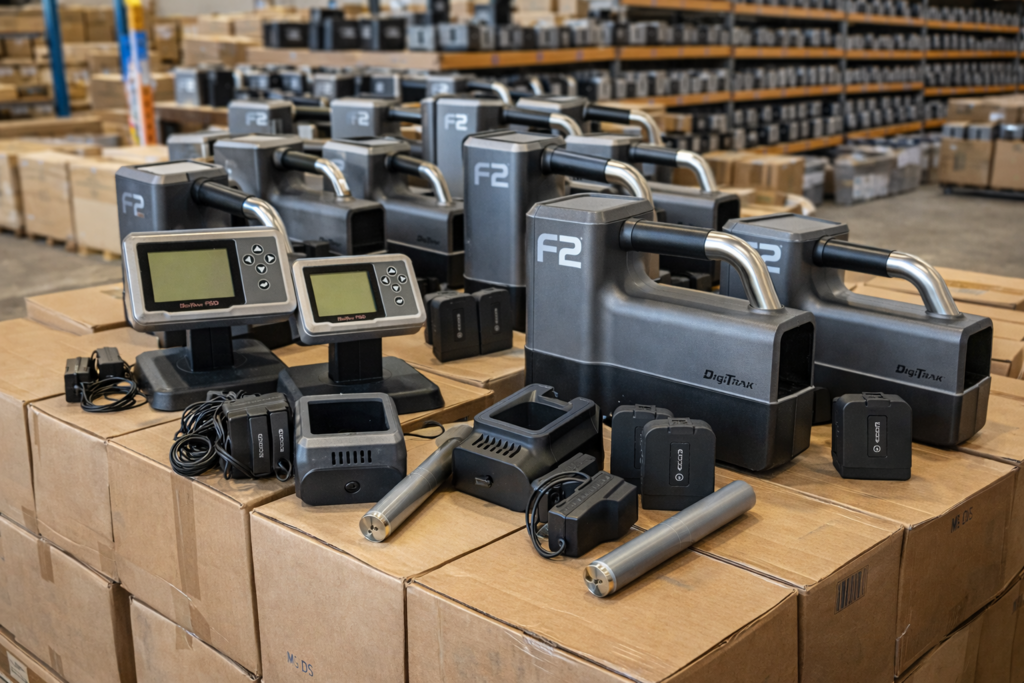
“Compatible” is not a marketing label. On a jobsite, compatibility is a chain of small truths you can confirm: your receiver can detect the transmitter signal, you can choose a usable channel, the readout stays stable, and the hardware survives the day.
That is why DigiTrak F2 compatibility questions almost always show up in commercial searches. Buyers want to avoid downtime and returns. Sellers want to prove what they have and what it can do. Both want a clear process.
This guide stays practical. It shows what to verify, what to ask for, and what to test, using jobsite language: receiver, transmitter, sonde, beacon, frequency, channel, signal strength, signal lock, interference, housing, battery cap, o-ring, sealing, water ingress, and condition notes.
UCG HDD buys and sells refurbished locating equipment. If you want to buy an F2 setup that fits what you already run, or you want to sell an F2 transmitter with clean proof and fewer back-and-forth messages, start at https://ucghdd.com/collections/digitrak-f2.
What “compatibility” means for DigiTrak F2 in the field
Compatibility is not one question. It is four.
First is signal detection. Your receiver must be able to see the transmitter signal at close range. If it cannot, nothing else matters.
Second is frequency and channel fit. A system can be compatible on paper and still fail on your jobsites because you cannot find a clean channel. Interference changes the outcome. Power lines, parallel utilities, rebar, traffic systems, and jobsite electronics all add noise.
Third is signal lock and stability. Detection is easy. Stability is what you need. You want a readout that holds, not one that drops, spikes, or turns intermittent as soon as you move, rotate, or drill.
Fourth is setup compatibility. The transmitter must physically work with your tooling and survive it. Housing condition, threads, battery compartment, battery cap fit, o-rings, and sealing surfaces decide whether the unit stays dry and powered. Water ingress and poor battery contact show up as weak signal and intermittent signal, not as a friendly warning label.
If you treat compatibility as a checklist, you stop gambling. You also get a better price outcome, because you can explain what you verified and why it matters.
Start with identification: what you have and what you’re buying
The fastest way to waste money is to use vague names. Listings regularly mix terms like “sonde,” “beacon,” “probe,” and “transmitter.” A buyer sees “F2 sonde” and assumes it will work with their receiver. A seller uses the term they heard on site. Then the deal collapses.
This section is about building a minimum data set that makes compatibility a solvable problem.
Receiver identification: what you must know before you talk compatibility
Write down the exact receiver model. Do not stop at “DigiTrak receiver.” Compatibility decisions depend on what the receiver can detect and how it handles channels.
Collect these items:
- Receiver model name
- Firmware version if you can access it
- Where you select channels and how you confirm you are locked
- Any known jobsite interference patterns you deal with
This is not paperwork. It is a control list. If you cannot name the receiver, you cannot verify signal compatibility. If you cannot select a channel and confirm lock, you cannot solve interference issues when the receiver says “not detected” or the readout goes unstable.
If you are buying refurbished locating equipment, this receiver list is the first message you should send to a seller. It turns your inquiry from “Do you have an F2?” into “Will this work with my setup?” Sellers respond faster to that because it is specific.
Transmitter identification: how to confirm it’s really a DigiTrak F2
For the DigiTrak F2 unit, ask for proof you can check in minutes.
Request:
- A clear photo of the label that shows DigiTrak F2
- A photo of the serial number
- Photos of the housing and any dents or deformation
- Photos of the battery compartment and battery cap
- Notes on what receiver it was last used with
Then look for condition risks that affect signal stability:
- Battery cap fit that looks loose or damaged
- Threads that look stripped or cross-threaded
- O-rings that look flattened, missing, or cut
- Any signs of moisture, corrosion, or grit on sealing surfaces
If the seller cannot provide label photos and serial number, treat the unit as unknown. You can still buy unknown gear, but you should price it like risk, and you should demand a return path or proof of testing.
Signal, frequency, and interference: where compatibility usually breaks
Most compatibility failures are not mysterious. They fall into two buckets: signal issues and noise issues.
Signal issues mean the receiver cannot detect the transmitter signal or cannot hold a stable lock even when interference is low. Noise issues mean the receiver can detect the signal, but jobsite interference overwhelms it, so the readout becomes unreliable.
You solve these problems differently. That is why good buyers ask for both specs and test proof.
Signal detection vs signal lock: what to verify and why it matters
A receiver can “detect” a transmitter at close range and still fail in the field. That happens when the signal-to-noise ratio collapses as distance grows or orientation changes.
When you verify compatibility, focus on three concepts:
- Detection: the receiver can see the transmitter signal at all.
- Lock: the receiver can commit to a channel and track it.
- Stability: the readout stays consistent as you move, rotate, and increase distance.
Weak batteries can mimic incompatibility. Poor battery contact can mimic interference. Water ingress can produce intermittent behavior that looks like a settings problem until you waste half a day chasing it.
That is why a basic bench test matters. It will not prove depth range on a specific job, but it can expose dead units, weak signal units, and intermittent signal units. A seller who can show stable signal behavior is answering the real buyer fear: downtime.
Channel fit and interference: the jobsite reality you must plan for
Interference is not an edge case. For many crews, it is the normal environment.
Common interference sources include:
- Power lines and electrical vaults
- Parallel utilities running close to the bore path
- Rebar and reinforced concrete structures
- Traffic systems and cabinets
- Jobsite electronics and nearby equipment
Treat interference as a compatibility factor. If you cannot choose a usable channel where you work, the system is not compatible with your workflow, even if it is “supported.”
When buyers ask “Which receivers work with DigiTrak F2?” the smart answer is not a vague list. The smart answer is: confirm receiver model capability, then confirm you can lock and hold a clean channel in your typical environment.
That is also why the best listings mention channels, frequencies, and test conditions. They show the seller understands the field constraints.
Physical setup compatibility: the condition checks that prevent downtime
If you buy used locating equipment long enough, you learn a simple rule: most failures are mechanical first, electrical second. A transmitter that cannot seal will eventually fail. A battery cap that does not fit will eventually cut power. That failure shows up as weak signal, intermittent signal, or “not detected” at the worst time.
Do not treat physical inspection as optional. It is part of compatibility because it determines whether the signal exists consistently.
Housing, threads, and sealing: what to inspect on every used unit
Inspect these areas before you trust any test result:
- Housing condition: dents, deformation, cracking
- Threads: stripped or cross-threaded threads prevent proper sealing
- Battery cap fit: loose caps create intermittent power and signal drops
- O-rings: flattened, missing, or cut o-rings invite water ingress
- Sealing surfaces: grit or damage ruins the seal even with a new o-ring
A transmitter can power on while still being compromised. Water ingress does not always announce itself with obvious puddles. It can leave subtle corrosion or residue. Once moisture enters, reliability becomes unpredictable. You might get a clean bench test and still lose stability on the job.
A seller who provides close-up photos of threads, cap, and sealing surfaces is doing the work buyers need. A buyer who asks for these photos is not being difficult. They are managing risk.
Battery system and contacts: why “fresh batteries” is not a cliché
Battery health is not a generic tip. It is a compatibility control.
Low voltage can reduce signal strength. Poor contacts can create intermittent signal behavior. Battery caps that do not seat properly can break contact under vibration.
When you test, control the easy variables:
- Use fresh batteries for any bench test
- Inspect the battery compartment for residue or corrosion
- Confirm the cap seats cleanly and consistently
- Watch for behavior changes when you tap, rotate, or gently stress the cap
If signal stability changes when you touch the cap or rotate the unit, you likely have a contact or sealing issue. That is a red flag for field reliability.
Step-by-step workflow: confirm DigiTrak F2 compatibility before you buy
A compatibility workflow should be repeatable. It should also be fast. The goal is not perfect certainty. The goal is to eliminate avoidable mistakes before money changes hands and before a bore starts.
Step 1: Collect the minimum data set before you negotiate price
Before you talk cost, collect proof.
Ask for:
- Receiver model details on your end
- Label and serial number photos for the F2 unit
- Photos of housing, threads, battery cap, o-rings, and battery compartment
- Any notes on testing: bench test, field test, or stable signal behavior
- What receiver the unit was last used with
This takes minutes and prevents days of regret.
If the seller cannot provide label and serial proof, treat the unit as uncertain inventory. You can still buy it, but you should negotiate like a professional: you are paying for risk.
Step 2: Run a basic bench test to confirm detection and stability
If you can test the unit, do a short, controlled bench test.
- Install fresh batteries.
- Power on and confirm normal startup behavior.
- Verify the receiver detects the signal at close range.
- Move away in a straight line and watch the readout.
- Rotate orientation and confirm the signal stays consistent.
You are not trying to “prove specs.” You are looking for stability signals and failure signals.
Failure signals include:
- Not detected at close range with fresh batteries
- Signal that appears, then drops out, then returns
- Readout that shifts wildly with small movements
- Behavior that changes when you touch the battery cap
Bench tests will not simulate every jobsite. They do catch many bad units.
Step 3: Run a short field check before the first job
Before you drill with a new-to-you transmitter, do a quick field check in a familiar environment.
- Choose a channel away from obvious interference.
- Confirm signal lock, not just detection.
- Watch for signal strength drops and unstable readings.
- Repeat after minor distance changes and orientation changes.
If you cannot hold a stable lock under light conditions, do not start a bore under real conditions. Fix settings, change channel, control batteries, and re-test. If the behavior persists, treat it as hardware risk.
How it works with UCG HDD: buying refurbished or selling a DigiTrak F2
Compatibility questions are commercial questions. People do not research compatibility for fun. They research it to buy with confidence or to sell without friction.
This section outlines the practical steps for both paths.
Buying refurbished locating equipment: what to prepare and what happens next
If you want to buy refurbished locating equipment, you can shorten the process by preparing the compatibility inputs up front.
Prepare:
- Your receiver model and how you select channels
- Your typical jobsite conditions, especially interference patterns
- What you need: transmitter only or a kit with accessories
- Any constraints that affect your schedule, such as shipping needs
What happens next:
- You share your receiver model and use case.
- You confirm the minimum compatibility points: detection, channel fit, and stable signal behavior.
- You review condition notes that matter for reliability: housing, threads, cap fit, o-rings, sealing.
- You decide based on risk controls, not just price.
Timeline reality:
- You can collect the receiver model and request proof photos in minutes.
- You can review label, serial, and condition photos quickly.
- Logistics timelines depend on shipping and distance, so confirm shipping details before you commit.
Start at ucghdd.com if you want to match a refurbished setup to your receiver and job conditions.
Selling to UCG HDD: how to get a faster, cleaner quote
If you want to sell a DigiTrak F2 transmitter, your goal is to remove uncertainty. Buyers and refurb shops ask the same questions because they face the same risk: will it work, and will it keep working.
Prepare:
- Photos of the label and serial number
- Close-ups of housing, threads, battery cap, o-rings, and battery compartment
- Honest notes on signal behavior: stable, weak signal, intermittent signal, or not detected
- The receiver model it was last used with
- A list of included items: housings, accessories, cases, spare caps
What happens next:
- You submit the details.
- The buyer evaluates condition and resale viability based on your proof.
- You get next steps based on what you provided.
Timeline reality:
- Complete, specific information reduces back-and-forth.
- Missing model data and missing close-ups slow everything down.
- You control speed by sending the minimum data set from the start.
Start at ucghdd.com to sell equipment to UCG HDD.
Compatibility checklist: quick go-no-go for buyers and sellers
| Check | Why it matters | What to collect |
| Receiver model identified | Compatibility depends on receiver capability and channel controls | Model name, settings screen if possible |
| F2 label and serial verified | Prevents mislabeling and wrong unit assumptions | Clear label photo, serial photo |
| Frequency and channel fit considered | Jobsite interference can make a “supported” unit unusable | Notes on where you work, how you choose channels |
| Signal lock and stability confirmed | Stable readout prevents downtime | Bench test notes or short test video |
| Battery system controlled | Low voltage and poor contacts mimic incompatibility | Fresh batteries, battery compartment photo |
| Housing, threads, cap, o-rings inspected | Sealing failures lead to water ingress and intermittent signal | Close-ups of threads, cap fit, o-rings |
| Condition notes and policy clear | Reduces financial risk | Condition summary, return or warranty terms |